Burn-out treatment with neurofeedback and personal guidance
Burn-out: when your body and mind can no longer recover
You work hard. You are responsible, committed and used to persevering. You often go the extra mile to meet expectations, hit deadlines or not let others down. But slowly you notice that it's not as easy as it used to be.

You wake up feeling tired. You're finding it harder to sleep. Your mind won't switch off. Things you used to enjoy now mainly drain your energy. Your concentration is waning, small tasks feel huge, and you notice you're becoming overstimulated more quickly.
Perhaps you also recognise that you need more coffee to get through the day, eat irregularly, or hardly feel like you have any space left to truly recharge.
At a certain point, you realise: this isn't just hustle. This feels like burnout.
At Brain-Fit, we help people with burnout symptoms to gradually build up more rest, resilience, and recovery capacity. We do this with NeurOptimal® neurofeedback, personal guidance and insight into the collaboration between the brain, nervous system, hormones, and recovery.
Do you recognise these burnout symptoms?
Burn-out usually doesn't happen overnight. It's often a process where you've been living beyond your capacity for too long. Your body and brain don't get enough time to recover, causing the stress system to remain increasingly active.
Many people with burnout recognise one or more of these symptoms:
- Extreme tiredness, even after sleep or rest
- Poor sleep or waking up unrested
- A busy mind or constant worrying
- Difficulty concentrating and making decisions
- Becoming more easily irritated, emotional, or overstimulated
- Less interest in work, social contacts or hobbies
- The feeling that you can't have anything anymore
- Creating distance from people or responsibilities
- Low self-esteem or doubt in your own abilities
- Anxiety, restlessness or tension in your body
- Physical complaints such as headaches, chest tightness, abdominal pain, or muscle tension
Burn-out is more than fatigue. It is a disruption of your entire system. Your brain, nervous system, hormonal balance, sleep pattern, and energy regulation can all be involved.
That's why at Brain-Fit, we don't just look at the complaint, but at your total capacity for recovery as a person.


What happens during a burnout?
With prolonged stress, your system is too often in action mode. Your body prepares itself to perform, solve problems or persevere. This is temporarily very useful, but if it lasts too long, the balance is disturbed.
Your brain becomes more sensitive to stimuli. Your nervous system finds it harder to switch back to a state of rest. Your sleep becomes lighter or more disturbed. Your energy depletes more quickly. This can lead you into a vicious cycle: you want to recover, but your system doesn't manage to relax sufficiently to enable that recovery.
That's precisely what neurofeedback and our additional guidance are focused on.
How can neurofeedback help with burnout?
NeurOptimal® neurofeedback is a brain training. During the session, the system measures brain activity via sensors. As soon as the brain responds less stably or less flexibly, it receives feedback via short interruptions in music or sound.
You don't need to do anything for it. You don't need to perform, talk, or consciously direct. The brain receives information and can thus learn to regulate itself better.
In the case of burnout, this can help to give the nervous system more flexibility. Many clients experience more peace of mind over time, better sleep, less tension, and more capacity to process daily stimuli.
Neurofeedback is not a quick fix, but a training. The goal is not to be able to push harder, but to allow your system to recover better.
Brain-Fit: a turning point for burnout
Brain-Fit can be a turning point in a life put on hold by burnout.
At Brain-Fit, we look at you as a whole. Not just your complaints, but also your resilience, recovery capacity, sleep patterns, stress response, energy levels, and lifestyle.
Our approach is aimed at increasing brain resilience and flexibility. This makes it easier to release tension, calm down better, and gain a step-by-step understanding of your recovery.
Many people notice that they gradually:
- Sleep better
- Experience less stress
- To get more peace of mind
- To feel less anxious or restless
- To concentrate better
- Become less easily overstimulated
- To regain more confidence in their body and mind.
We work personally, calmly and without judgment. It's precisely with burnout that it's important not to feel pressured to perform again.
More insight with the Neuro-4 profile test
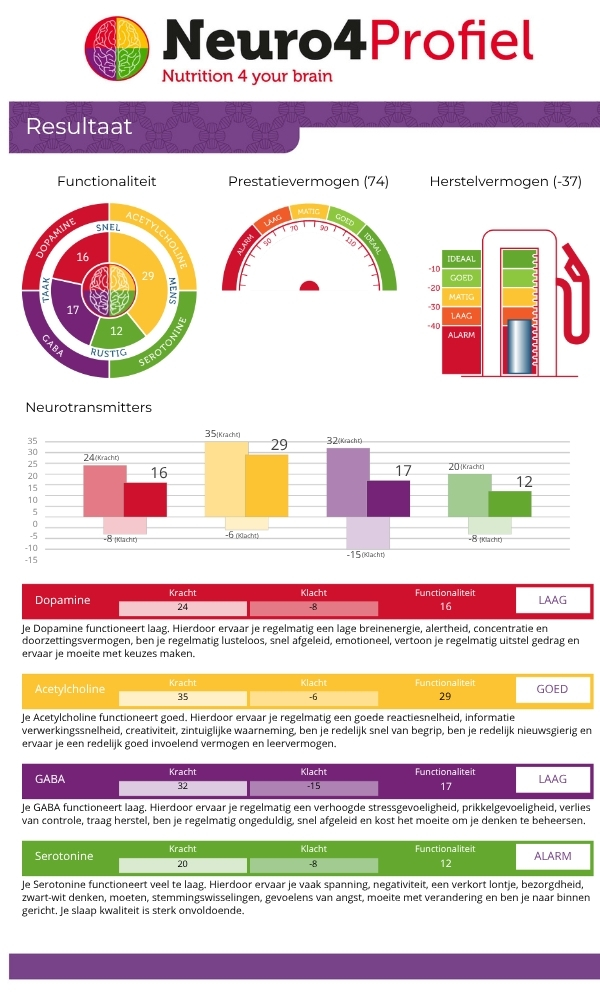
At Brain-Fit, we use the Neuro-4 profile test to get a better understanding of your recovery and performance capabilities.
This profile test helps to gain insight into factors that can influence your energy levels, susceptibility to stress, recovery capacity, and resilience. This includes how your body reacts to prolonged stress, how well you can recover, and where potential imbalances between mind and body might lie.
The Neuro-4 profile test is not a standard questionnaire that merely inventories complaints. It helps us to look more specifically at what you need to recover better.
This way, we can tailor the support to your personal situation.
Neurofeedback and PNEI in burnout
With burnout, there is often more going on than just mental overload. The body is involved. Think of stress hormones, sleep, susceptibility to inflammation, gut health, nutrition, recovery capacity, and the autonomic nervous system.
This is why at Brain-Fit we combine neurofeedback with knowledge from Psycho-Neuro-Endocrino-Immunology, also known as PNEI.
PNEI looks at the collaboration between:
- The brain
- The nervous system
- The endocrine system
- The immune system
- Nutrition, lifestyle and recovery
This broad perspective helps to better understand burnout complaints. You not only get training for your brain, but also insight into what your system needs to become stronger and more stable again.

Who is this burnout coaching suitable for?
Our guidance is suitable for people they notice that they are getting stuck due to stress, overload or burnout symptoms.
You can come to Brain-Fit if you:
- Being tired for a long time
- Having trouble recovering
- Sleeps badly or wakes up exhausted
- Unable to cope with your work or daily tasks anymore
- Becomes overstimulated quickly
- Experiencing a lot of tension, unrest, or anxiety
- Not recovering well after a period of stress
- To prevent further hair loss
- A more peaceful and sustainable recovery
Even if you're not yet sure if you have burnout, but you feel your system is under pressure, an initial consultation can bring clarity.
Why choose Brain-Fit?
By Brain-Fit You don't get a standard treatment plan. We look at your symptoms, your background, and your ability to recover.
What characterises our approach:
- Personal guidance in a calm setting
- Training with NeurOptimal® neurofeedback
- Attention for brain and body
- Insight through the Neuro-4 profile test
- Broad outlook from PNEI
- Extensive experience with stress, burnout, overstimulation, and recovery
- Locations in Hillegom and Amstelveen
- Possibility to train neurofeedback at home with a rental system
Our guidance is accessible, practical, and paced to your speed.
Neurofeedback at home for burnout
For some people, it is pleasant to Home neurofeedback to train. Especially with burnout, travelling or planning can be an extra strain.
With a neurofeedback rental system, you can train at home at times that suit you. This provides peace of mind, flexibility, and often lower costs per training session.
At Brain-Fit, you're not on your own. You receive explanations, guidance and personalised adjustments, so you know how to use the system and how to build the programme.
Training from home can be particularly suitable if you:
- Little energy to come to the practice.
- Peaceful training in your own environment
- How often per week do you want to train
- To support your recovery in a flexible way
- Neurofeedback combined with personal guidance
During the intake, we'll discuss what's most suitable for you: training at the location, training at home, or a combination of both.
What does a journey look like?
A programme at Brain-Fit always starts with an intake. We will discuss your complaints, your energy levels, your sleep, your stress load, and your recovery history.
After that, we'll look at which approach best suits your needs. This may involve in-person neurofeedback sessions, a home-based programme with a rental system, and additional guidance based on PNEI insights (Neuro-4 profile test).
A process usually proceeds in steps:
- Intake and introduction
We survey your complaints, goals, and situation. You will receive a shortened neurofeedback session. - Understanding resilience
Using, among other things, the Neuro-4 profile test and the medical history form, we look at factors that influence your recovery. - Begin neurofeedback training
Train your brain with NeurOptimal® neurofeedback, on-site or at home. - Personal guidance
We will monitor your reaction to the training and adjust the course as needed. - Building rest, energy, and resilience
The goal is for your system to learn to switch between exertion and recovery better again.
Take the first step towards recovery
Burn-out often feels like you've lost yourself. As if your body is applying the brakes, while your head still wants to push forward.
You don't have to figure it out on your own.
At Brain-Fit, we help you rebuild calm, clarity, and resilience. With neurofeedback, personal coaching, and attention to your system's total recovery capacity.
Would you like to know what Brain-Fit can do for you with burnout? Schedule an intake and discover which approach suits your recovery.
Frequently Asked Questions about Burnout and Neurofeedback
Helps neurofeedback with burnout?
Neurofeedback can offer support for burnout by providing the brain with feedback during moments of instability or overload. The goal is to improve the flexibility of the brain and nervous system, enabling you to relax more easily and recover better. Many clients experience more peace, improved sleep, and less overstimulation over time.
Do I need to do anything during the neurofeedback session?
No. During training, you don't need to consciously direct or practise anything. You sit or lie relaxed while listening to music or watching a film. The system provides feedback through short interruptions. Your brain processes that information in a natural way.
Is neurofeedback suitable if I am very tired?
Yes, neurofeedback can be particularly beneficial during periods of fatigue or overexertion, as it doesn't require you to perform. However, we always tailor the programme to your capacity. In cases of severe exhaustion, we build up gradually.
How quickly will I see results?
That differs from person to person. Some people already notice more calm or better sleep after a few sessions. For others, the system needs more time. Burn-out often arises from prolonged overload, so sustainable recovery usually also requires time and repetition.
Can I combine neurofeedback with coaching, therapy, or guidance from my GP?
Yes. Neurofeedback can also be used effectively alongside other forms of support. It does not replace medical treatment, but it can be a valuable addition to recovery from stress and burnout.