Many people who come to Brain-Fit eventually ask the same question: Does NeurOptimal® neurofeedback really help? Often, a long search has preceded this. You may be suffering from stress, burnout symptoms, sleep problems, overstimulation, concentration problems or post-concussion symptoms. You've tried everything, but your mind just won't switch off.
The honest answer is: Many people experience clear improvement through NeurOptimal® neurofeedback, but it is not a miracle cure and not a medical treatment that cures a diagnosis. It is a form of brain training that helps the brain to regulate itself better. It can make a big difference, especially with complaints where the nervous system is out of balance.
What is NeurOptimal® neurofeedback?
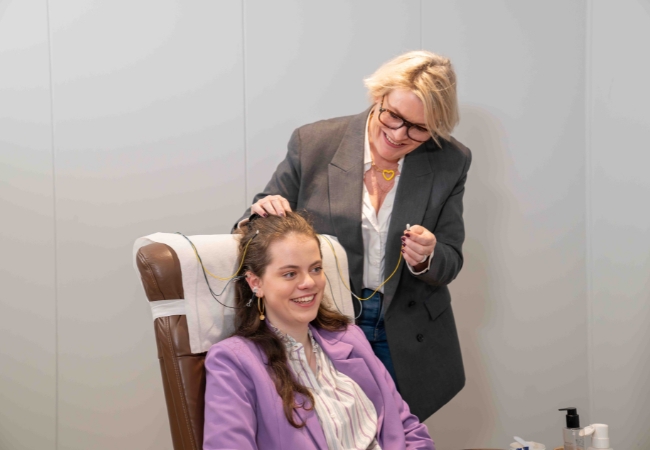
NeurOptimal® is a form of dynamic neurofeedback. During a session, you sit relaxed in a chair and listen to music or watch a film. Brain activity is measured via sensors. As soon as the system registers sudden changes or instability, you will hear a very brief interruption in the sound.
The interruption is not a punishment, a command, or a deliberate exercise. It is a signal to the brain: “Pay attention, something is changing here.” Through this, your brain receives information about its own activity and can adjust itself.
So you don't have to do anything right. You don't have to concentrate extra hard. You also don't need to talk about your complaints if you don't want to. The system works in the background, while your central nervous system receives the feedback.
NeurOptimal® itself describes the system as an automated form of brain training, not as a medical diagnostic tool or medical treatment. That distinction is important, as neurofeedback at Brain-Fit is used to support the brain's self-regulating capacity.
How can neurofeedback help?
Your brain is constantly adapting. It responds to stimuli, emotions, sleep, stress, pain, nutrition, exercise, and recovery. When your nervous system is flexible and resilient, you can usually switch well between exertion and relaxation.
However, with prolonged stress, burnout, concussion, post-COVID, anxiety disorders, or sleep problems, for example, that system can become disrupted. You then notice, for instance, that you:
- gets overstimulated quickly;
- sleep poorly or wake up feeling unrested;
- difficulty concentrating;
- reacts more emotionally;
- experiencing a headache or pressure in your head;
- unable to recover fully after exercise;
- continue on;
- you are less taxable than before.
Neurofeedback doesn't try to force the brain. It feeds information back to the nervous system, allowing the brain to develop more flexibility and resilience. Many clients describe the effect as: more peace of mind, better sleep, less overstimulation, more focus, and increased resilience.
Does it really help with concussion (PCS)?
At Brain-Fit, we see many people with Complaints after a concussion (PCS – post-concussion syndrome). These people often recognise that their complaints are “invisible”, but can be enormously limiting on a daily basis. Think of sensitivity to light and sound, fatigue, concentration problems, headaches, dizziness, or the feeling that your brain quickly becomes overloaded.
NeurOptimal® neurofeedback can be interesting in such situations because it doesn't require strenuous mental effort. You don't have to do exercises that temporarily worsen your complaints. You simply sit quietly while your brain receives feedback on its own activity.
This makes neurofeedback easily accessible for many people with overstimulation or concussion symptoms. The goal is not to “treat away” a concussion, but to support the brain in recovery, regulation, and resilience.
And for burnout, stress, and sleep problems?
When experiencing stress and burnout, the nervous system is often in a prolonged “on” state. Your body and brain remain alert, even when rest is actually needed. This can leave you feeling tired, yet unable to relax properly. Your mind keeps racing, you sleep lightly, you don't wake up feeling refreshed, or you notice yourself becoming overstimulated more easily.
It is precisely in these situations that NeurOptimal® neurofeedback can be valuable. The system gently provides the brain with information about its own activity. This gives the brain repeated opportunities to self-correct and more easily return to a state of greater calm, balance, and flexibility.
Many clients find their minds become calmer after a number of sessions. They sleep more deeply, react less frantically, can tolerate stimuli better and feel more resilient throughout the day. People also often notice that they get less stuck in tension or worrying thoughts.
At Brain-Fit, we see stress, burnout and sleep problems not as isolated complaints, but as signals of a nervous system that has become unbalanced. NeurOptimal® neurofeedback connects well with this, as it does not work by forcing, talking, or performing. Your brain receives feedback while you sit relaxed, listen to music, or watch a film.
From the PNEI perspective, we also look at factors that can support recovery, such as sleep patterns, sensory load, nutrition, breathing, stress accumulation, and recovery periods. In this way, we combine NeurOptimal® neurofeedback with a broader view of the nervous system and the body's self-healing capacity.
The aim is for your system to develop more calm, stability, and resilience step by step. Not just during the session, but also in everyday life.
What does research say about neurofeedback?
Neurofeedback has been the subject of scientific research for years. Studies have shown positive effects in areas including ADHD, emotion regulation, trauma-related complaints and broader mental health issues. A meta-analysis from 2024 concluded that neurofeedback demonstrated a clinically meaningful effect in the studies examined, with newer forms of neurofeedback appearing to enhance this effect.
At the same time, it is important to remain honest: not every study is equally robust, not every type of neurofeedback is the same, and not every client responds in the same way. ADHD neurofeedback is often being researched as a supplementary or alternative approach, but the results vary depending on the protocol and study design.
For NeurOptimal® specifically, there is less large-scale clinical research than for some traditional neurofeedback protocols. However, there are publications, practical experiences, and smaller studies surrounding dynamic neurofeedback and well-being, but there is a need for more independent and large-scale research.
The most careful conclusion is therefore:
Neurofeedback shows promise and many clients experience improvement, but the effect varies from person to person. NeurOptimal® should be seen as brain training and support for self-regulation, not as a medical guarantee or a replacement for regular care.
When do you notice effects?
Some people notice a difference after just a few sessions. For example, they sleep more soundly, feel less overwhelmed, or have a clearer mind. For others, the effect is more subtle and builds up gradually.
That makes sense. A brain that has been under pressure for months or years often needs time to regain stability. Particularly with burnout, PCS, post-COVID, or prolonged stress, recovery is usually not a straight line. There can be good days and bad days.
At Brain-Fit, we therefore don't just look at one complaint, but at the whole picture:
- How do you sleep?
- How many stimuli can you handle?
- How quickly do you recover after exertion?
- What is your concentration like?
- When you're stressed, your body goes into "fight or flight" mode. This is an automatic response that prepares you to either confront or escape a threat. Here's what happens: * **Hormones are released:** Your adrenal glands release stress hormones like adrenaline and cortisol. * **Heart rate increases:** This pumps more blood and oxygen to your muscles and brain. * **Breathing speeds up:** This allows you to take in more oxygen. * **Muscles tense up:** This readies your body for action. * **Digestion slows down:** Your body diverts resources away from non-essential functions. * **Your senses heighten:** You become more aware of your surroundings. These changes are designed to help you deal with immediate danger. However, if stress is prolonged or chronic, these responses can have negative effects on your physical and mental health.
- How does your head feel at the end of the day?
- Can you participate more in work, family, school, or social activities again?
The aim is not simply fewer complaints. The aim is for your daily functioning to improve.
Who is NeurOptimal® neurofeedback for?
NeurOptimal® neurofeedback may be suitable for children, adolescents and adults They notice that their brain or nervous system is out of balance. At Brain-Fit, we work a lot with people who experience complaints such as:
- Post-concussion syndrome (PCS);
- Burnout or prolonged stress;
- sleep problems;
- Overstimulation;
- anxiety symptoms;
- ADHD or ADD;
- concentration problems;
- headache or migraine;
- Post-COVID symptoms;
- Mental fatigue.
An intake is important to determine whether neurofeedback is suitable for your situation. Sometimes, an additional medical assessment is necessary. In cases of sudden, severe, or unexplained complaints, we always advise you to first contact your GP or medical specialist.
Why Brain-Fit?
Brain-Fit works with NeurOptimal® neurofeedback and additional support from the PNEI (Psycho-Neuro-Endocrino-Immunology) perspective. This means we look not only at brain activity but also at the interconnectedness of the brain, stress system, hormones, immune system, lifestyle, and resilience.
This is important, as complaints rarely arise from a single factor. Particularly with burnout, concussion, post-COVID, and sleep problems, a combination of sensory processing, energy regulation, sleep, stress load, diet, and recovery often plays a role.
Brain-Fit has locations in Hillegom and Amstelveen and supports clients from, among others, Haarlem, Leiden, the Bollenstreek, Hoofddorp, Haarlemmermeer, Amsterdam, Amstelveen, Aalsmeer and Almere.
Does NeurOptimal® neurofeedback really help?
For many people, yes, they find that NeurOptimal® neurofeedback helps them to develop more calm, focus, sleep quality, and resilience. Brain training can be particularly valuable when issues are related to nervous system dysregulation, overstimulation, or prolonged stress.
But it's important to stay realistic. Neurofeedback is not a quick fix. It is not a medical treatment that cures diagnoses. And the result is not the same for everyone.
What it *can* be: a gentle, safe, and accessible way to support your brain in finding its balance again.
Would you like to know if neurofeedback is right for you?
Are you stuck with symptoms after a concussion, burnout, stress, sleep problems, or overstimulation? Then it may be worthwhile to explore whether NeurOptimal® neurofeedback is suitable for you.
At Brain-Fit, we begin with an Intake session where we discuss your symptoms, your current capacity, and your recovery goals. This way, you receive honest advice on what to expect and which approach will best suit you.
Plan an intake session at Brain-Fit and discover if neurofeedback can help your brain find more calm, focus, and balance again.
Frequently asked questions
Is NeurOptimal® neurofeedback scientifically proven?
Neurofeedback has been scientifically researched and studies show positive effects. For NeurOptimal®, specifically, research is more limited than for some traditional forms of neurofeedback. Therefore, we prefer to speak of brain training and support rather than cure or medical treatment.
Is neurofeedback safe?
NeurOptimal® is non-invasive. Nothing is sent into your brain, and no electricity is administered. The sensors measure activity, and the system provides feedback through brief interruptions in sound. The methodology is therefore safe and effective.
How many sessions do I need?
This varies from person to person and complaint to complaint. Some people notice a change quickly, others need more time. For long-term complaints such as burnout, PCS or post-COVID, a course of treatment is often necessary to support sustainable improvement. We always allow for a range of 10-20 sessions.
Kan neurofeedback helpen na een hersenschudding?
Many people experiencing post-concussion syndrome find neurofeedback beneficial, as it requires little effort and focuses on regulating the nervous system. It is not a replacement for medical care, but can be supportive in recovery and improving resilience.
Can I combine neurofeedback with other treatments?
Yes, this can often be beneficial. Neurofeedback can be used as an addition to regular care, coaching, physiotherapy, psychological guidance, or lifestyle adjustments. Always consult your practitioner for medical complaints.